Hemp is having a maturation moment. After several speculative years, 2026 is shaping up to be the season the US industrial hemp industry settles into legitimate agricultural and industrial integration – fiber and grain operations scaling up, processing infrastructure catching up with production, and hemp increasingly discussed as “climate infrastructure” in carbon-market and regenerative-agriculture pilots. None of that works without the soil underneath it doing its job.
For growers running fiber, grain, or CBD biomass operations, that raises a practical question: what actually goes into that soil, and what’s it doing to it long after the season ends?
Why hemp growers are looking past the bottle
Synthetic, bottled nutrient programs built the industry’s first wave – fast, predictable, easy to dose. But a growing share of hemp operations are shifting toward organic inputs that build living, biologically active soil instead of feeding the plant directly and leaving the soil largely unchanged season to season. Rodale Institute’s ongoing multi-year hemp grain trials, run with USDA-ARS, are a good example of where the research is heading: testing cover crops like triticale and hairy vetch alongside hemp to reduce erosion, store carbon, suppress weeds, and support beneficial soil microbes – with the explicit goal of helping farmers “grow more hemp grain, with better nutrition, using practices that build up their soil rather than deplete it.”
That same research has found strong arbuscular mycorrhizal fungal colonization in hemp fiber roots – in the range of 37% to 54% – suggesting hemp is well set up to form the kind of fungal partnerships that improve nutrient and water uptake, provided the fertility program doesn’t work against them.
What hemp actually needs from the soil
Hemp is a heavy nitrogen feeder through vegetative growth, benefits from steady rather than spiky potassium for stress resistance, and – like most crops – does better with a fertility program that keeps soil biology intact rather than one that relies on concentrated synthetic salts. Whether the end product is fiber, grain, or biomass, the underlying agronomic need is the same: consistent nutrient release, strong root development, and soil structure that improves rather than degrades over repeated seasons.
Where wool pellets fit into a hemp feeding program
Wool is already trusted by vegetable and vineyard growers across Europe for exactly this reason. A few properties matter specifically for hemp:
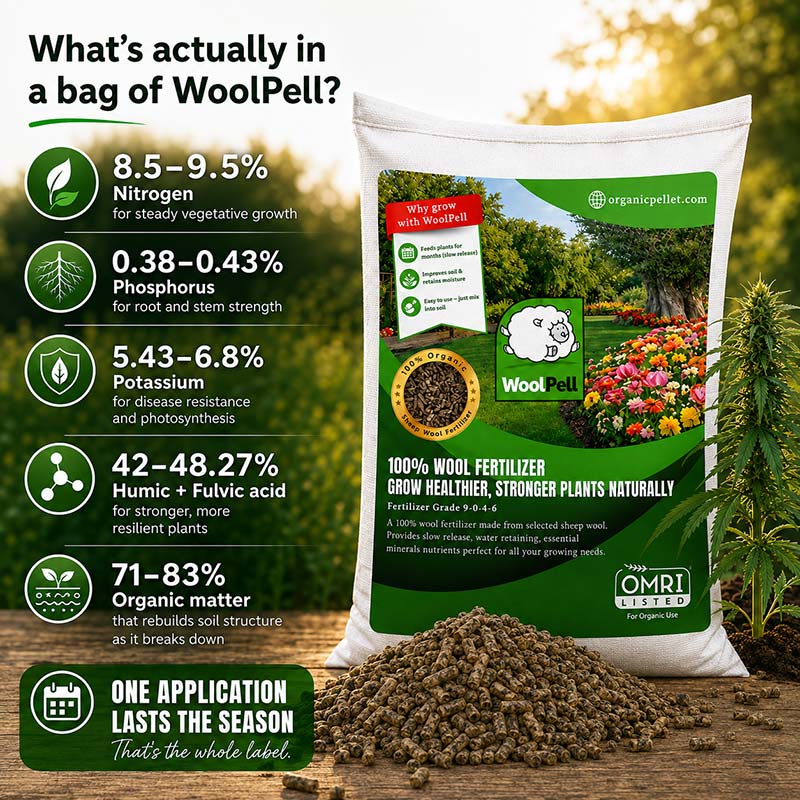
- Slow, steady nitrogen. Wool is naturally nitrogen-rich (8.5-9.5% in Woolpell), and as soil microbes break down the keratin fibers, that nitrogen releases gradually over the season rather than in a single spike.
- Water retention. Wool absorbs many times its own weight in water and releases it back as soil dries out, reducing water use by up to a third – a meaningful buffer during dry stretches in vegetative growth.
- Soil structure and protection. As the pellets break down, they aerate the soil, help it hold both air and moisture, and support the microbial and fungal activity hemp roots are already primed to take advantage of.
A practical starting point for dosing
Woolpell hasn’t been trial-dosed specifically on hemp yet, so the safest approach is to treat it as a comparable heavy feeder – in the range used for tomatoes and cucumbers (roughly 150g/m² mixed into planting soil) – and adjust from there based on soil test results, bed size, and crop stage. As with any new organic fertilizer, it’s worth starting conservative, particularly in containers or raised beds where nutrient concentration builds faster than in open field soil.
The bigger picture
None of this replaces good genetics or good growing practice – soil biology modulates what a crop can do, it doesn’t substitute for it. But for hemp operations weighing a move away from synthetic, bottled nutrient programs, wool pellets offer a straightforward way to build soil that keeps performing season after season, not just this one.
Curious whether Woolpell fits your setup? Get in touch and we can help you work out a starting dose for your beds or containers, or read more about what the science says about wool pellets as organic fertilizer and how wool pellets fit a cannabis feeding program.