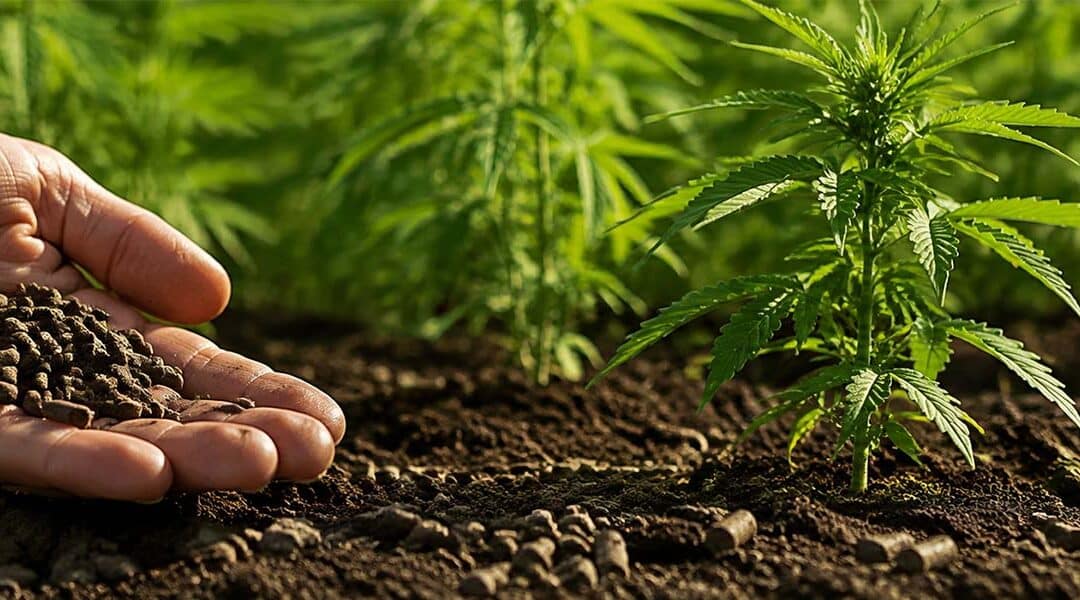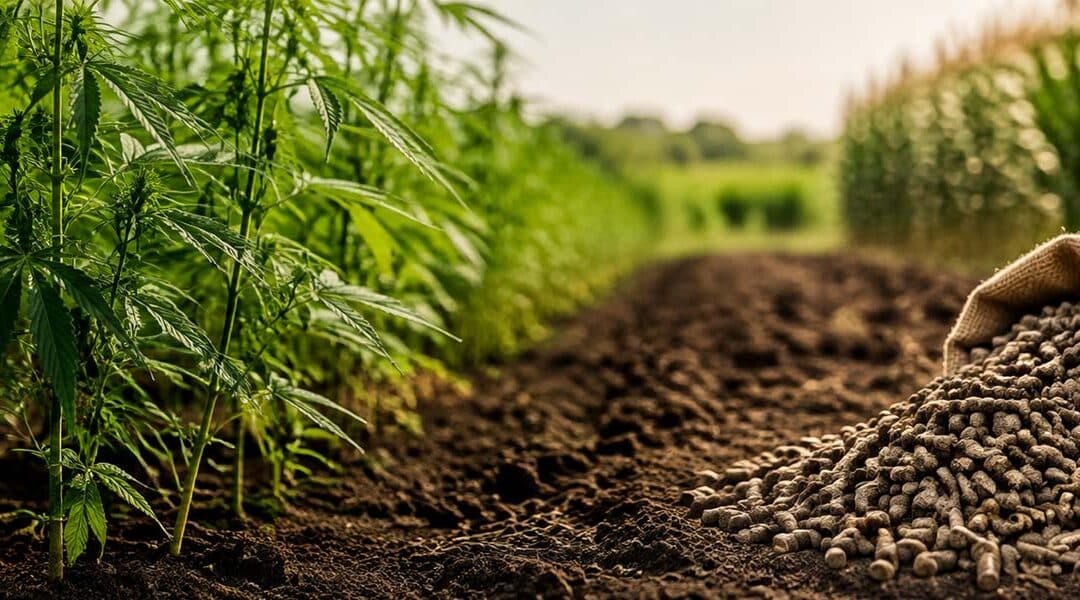
Synthetic bottled nutrients built the legal industry’s first wave, but a growing share of craft and licensed cultivators are now searching for organic fertilizer for cannabis that can build living, biologically active soil instead of feeding the plant directly, cycle after cycle.
Wool pellets – already trusted by vegetable and vineyard growers across Europe – are a natural fit for that shift. Here’s what’s driving the trend, what the research actually shows, and how a slow-release, OMRI Listed input like Woolpell fits into a cannabis feeding program.
Living soil cannabis cultivation isn’t a niche trend anymore
Soil-based cultivation held an estimated 43.7% of the US cannabis cultivation market in 2025, and the craft cannabis segment – much of it grown in living or organically amended soil – was valued at roughly $4.5 billion in 2024, with some craft flower commanding up to twice mainstream pricing. That premium is being paid for a reason: consumers increasingly ask who grew their cannabis and how, not just what the THC number says. Regenerative and organic-leaning cultivation is projected to keep growing quickly as part of a cannabis cultivation market expected to more than double by the early 2030s.
Because cannabis remains federally restricted, growers can’t put a “USDA Organic” label on flower the way a tomato farmer can. Independent standards have stepped into that gap instead. Programs like Sun+Earth Certified require farms to maintain living soil “teeming with life,” ban synthetic fertilizers and toxic pesticides outright, and verify microbial abundance through soil testing. Clean Green Certified applies a similar organic-equivalent standard. For growers pursuing certifications like these – or simply marketing themselves as clean and sustainable – every input in the soil has to earn its place, which is exactly why OMRI-listed, additive-free materials are getting a second look.
What the research says about organic cannabis nutrition
The appeal isn’t just marketing. Research increasingly backs up what regenerative growers have argued for years. A 2022 study on arbuscular mycorrhizal fungi (AMF) found that inoculating cannabis with beneficial fungi matched or exceeded synthetic NPK fertilizer for both biomass and cannabinoid concentration – and that high-phosphorus synthetic feeding actually suppressed the fungal colonization growers were trying to build. A 2023 study on bacterial soil inoculants found roughly an 11% increase in total THC and CBD, with the timing of application making a measurable difference. The throughline in both cases: healthy soil biology needs to be fed and protected, not overwhelmed by fast-release synthetic salts.
That’s the mechanism living soil relies on. Rather than feeding the plant directly, organic fertilizer for cannabis feeds a soil food web – bacteria, fungi, and microarthropods – that in turn makes nutrients available to roots on a schedule closer to how the plant actually wants to take them up. It’s slower than a bottle of synthetic bloom nutrient, but it’s also far more forgiving, and it builds soil structure that keeps performing season after season instead of depleting it.
Where wool pellets fit into a cannabis feeding program
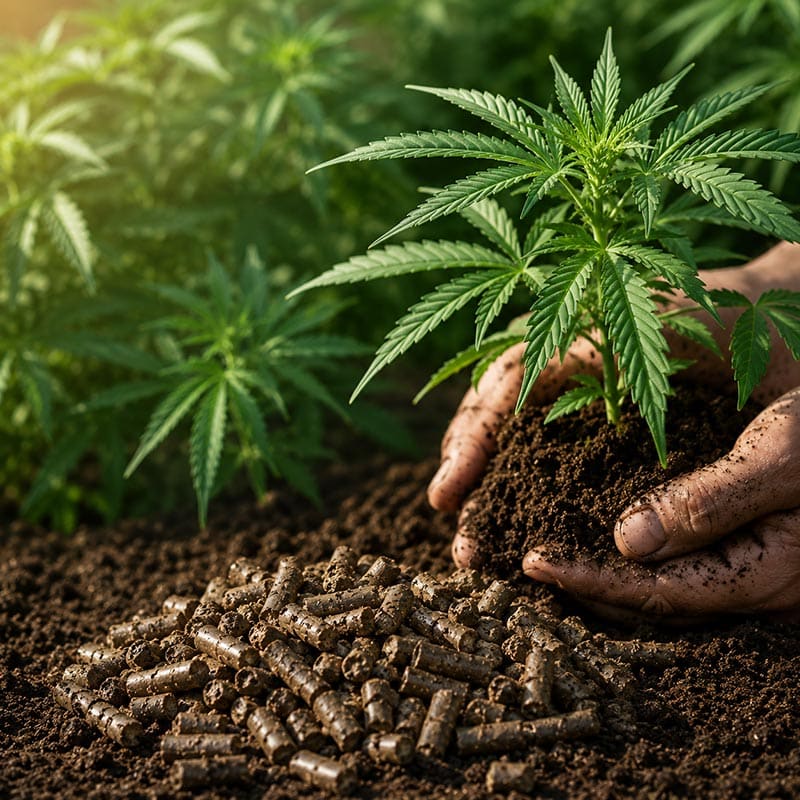
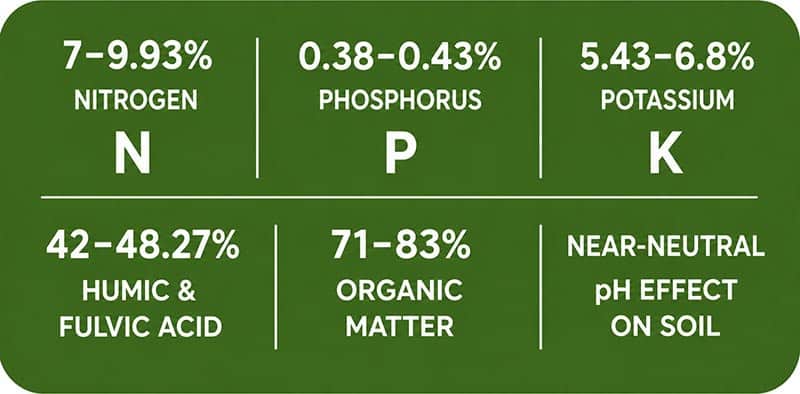
Wool is one of the more interesting materials to come out of this shift, mainly because it was already sitting in a waste stream. Coarse, low-grade wool unsuitable for textiles is often landfilled or burned; processed into pellets, it becomes a genuinely useful slow-release soil amendment. Independent lab analysis of Woolpell puts it at 7-9.93% nitrogen, 0.38-0.43% phosphorus, 5.43-6.8% potassium, 42-48.27% humic and fulvic acid, and 71-83% organic matter, with a near-neutral pH effect on soil. It’s OMRI Listed, meaning it’s approved for use in organic production systems – a meaningful credential for growers who need to document every input for a certification audit.
A few properties matter specifically for cannabis growers:
- Slow, steady nitrogen. Wool is naturally nitrogen-rich, and as soil microbes break down the keratin fibers, that nitrogen releases gradually over roughly 10 months rather than all at once. That maps closely onto cannabis’s vegetative-stage needs, when plants want a nitrogen-forward feed (growers commonly target something like a 3-1-2 N-P-K ratio) to drive leaf and stem growth without the salt buildup or burn risk that comes with concentrated synthetic nitrogen.
- Water retention. Wool can absorb many times its own weight in water and release it back gradually as soil dries out. On Woolpell specifically, growers have seen water use drop by up to a third. For outdoor and greenhouse cultivators in drought-affected states across the West, that’s not a minor convenience – it’s a real input-cost and water-rights consideration.
- Low phosphorus, by design. Cannabis flips its nutrient demand in flower, shifting toward phosphorus and potassium (something closer to a 1-3-2 ratio) to drive bud development. Wool pellets are deliberately light on phosphorus, which avoids the phosphorus buildup that comes from repeated bone meal or guano applications – but it also means growers should plan to layer in a bloom-stage P-K source once flowering starts, rather than relying on wool pellets alone through the whole cycle.
- Soil structure and protection. As the pellets break down, they aerate the soil and improve its ability to hold both air and moisture – useful in both sandy, fast-draining mixes and heavier clay-based beds. Growers have also reported wool’s natural scent helping deter rodents and its texture discouraging slugs and snails around the root zone, a welcome side benefit for anyone managing an outdoor or living-soil bed without synthetic pesticides.
A practical starting point for dosing
Because Woolpell hasn’t been trial-dosed specifically on cannabis, the safest approach is to treat it like other heavy-feeding crops in its existing dosing guide – tomatoes and cucumbers, for example, are dosed at roughly 150 g/m² mixed into the planting soil – and adjust from there based on container size, soil type, and how the plant responds.
As with any new organic fertilizer for cannabis, it’s worth starting conservative, especially in containers, and scaling up in future cycles once you’ve seen how your specific soil mix and genetics respond.
The bigger picture
None of this replaces good genetics or good growing practice – soil biology modulates what a cultivar can do, it doesn’t override it. But for cultivators building living soil, chasing an organic-equivalent certification, or simply trying to cut synthetic inputs and water use without sacrificing yield, a slow-release, OMRI Listed wool fertilizer is a straightforward way to feed the soil food web instead of just the plant. It’s a fitting use for a byproduct that used to be waste, and a good match for where craft cannabis cultivation in the US is heading.
Curious whether Woolpell fits your setup?
Get in touch and we can help you work out a starting dose for your beds or containers, or read more about what the science says about wool pellets as organic fertilizer.